Latest Research Achievement Published by Professor Li Yunli’s Research Group in Automation in Construction
Recently, Professor Li Yunli’s research team has published a paper titled “Nature-inspired ML for strength estimation and multi-objective optimization of cement–supplementary cementitious material–stabilized soft soils” in the internationally leading journal Automation in Construction in the field of civil engineering.
Dr. Onyekwena Chikezie Chimere is the first author, and Professor Li Yunli is the corresponding author. Automation in Construction is a highly authoritative international journal published by Elsevier, focusing on digitalization and automation technologies across the full life cycle of construction. It emphasizes digital construction, intelligent construction technologies, and automation applications in the construction industry. The journal is a Q1 Top Journal indexed in the Chinese Academy of Sciences, with an impact factor of approximately 11.5. The paper can be accessed at: https://doi.org/10.1016/j.autcon.2026.106880
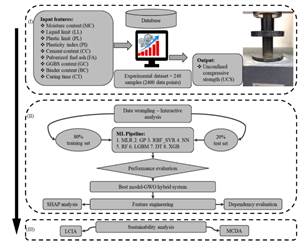
System model
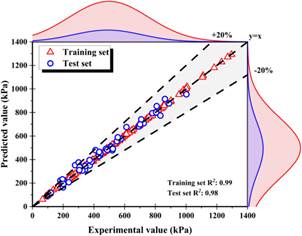
Experimental and predicted UCS values of the XGB-GWO model
The stability reconstruction of weak soft ground in soft soil engineering remains a major challenge in geotechnical engineering, requiring a balance between mechanical performance and sustainability. To address this issue, the study proposes an automated optimization framework that integrates machine learning (ML) with nature-inspired optimization algorithms for the design of cement–supplementary cementitious material (SCM) composite stabilizers, enabling efficient soft soil stabilization.
The results demonstrate that the proposed method achieves strong predictive performance and provides important guidance for the sustainable utilization of supplementary cementitious materials such as ground granulated blast furnace slag (GGBS). While ensuring mechanical performance, it also effectively reduces environmental impacts. This study establishes an intelligent design framework for sustainable ground improvement and offers significant guidance for the engineering application of low-carbon stabilized soils, aligning with China’s “dual carbon” goals and the strategic development of green construction and sustainable infrastructure.
Research Overview of Professor Li Yunli’s Group
Professor Li Yunli’s research group has long been engaged in systematic research on major fundamental and frontier scientific problems in geotechnical and geological engineering. Their research directions include:
· Mechanical behavior of special soils
· Soil–structure interaction
· Fracture and damage mechanics of engineering materials
· Machine learning and data-driven methods in geotechnical engineering
In recent years, the group has made significant progress in deep space exploration and intelligent geotechnical computation. They have successfully obtained the 9th batch of lunar scientific samples and are actively conducting research on the engineering properties and fundamental theories of lunar regolith and planetary soils.
The team has published more than 40 papers in high-impact journals such as Automation in Construction, International Journal of Plasticity, Journal of Rock Mechanics and Geotechnical Engineering, Construction and Building Materials, Applied Soft Computing, Acta Astronautica, Powder Technology, Granular Matter, Journal of Aerospace Engineering, Scientia Sinica, and Journal of Deep Space Exploration, among others.
These achievements have made significant contributions to both fundamental theory and engineering applications, providing strong support for intelligent, low-carbon, and high-reliability development in geotechnical engineering.

