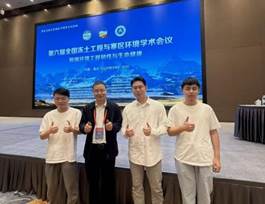
Faculty Members and Students from the School of Civil Engineering and Architecture Attended the 6th National Conference on Permafrost Engineering and Cold Regions Environment in Chongqing
From May 8 to 10, 2026, the 6th National Conference on Permafrost Engineering and Cold Regions Environment was successfully held in Chongqing. Centered on the theme of “Engineering Resilience and Human Health in Extreme Environments,” the conference brought together renowned experts and scholars from dozens of universities and research institutes across China to discuss major topics including permafrost environmental evolution, cold-region engineering safety, and frontier issues in geotechnical engineering. The School of Civil Engineering and Architecture of Wuhan Institute of Technology actively organized faculty members and postgraduate students to participate in the conference and engage in academic exchanges.
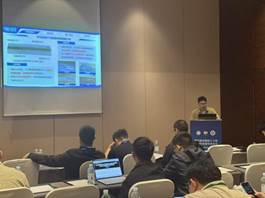
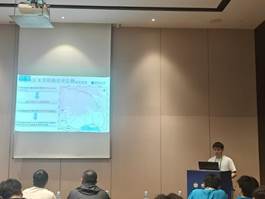
During the conference, Professor Li Yunli delivered a keynote presentation entitled “Research on the Dynamic Mechanical Properties of Chang’e-5 Lunar Soil Samples.” In her report, she systematically introduced the research team’s latest progress in this field, which attracted extensive attention and lively discussions among participating experts and scholars.
At the postgraduate forum, master’s students Zhang Junhao and Lu Xiangyu, supervised by Ms. Wang Huini, presented their respective research achievements. Among them, Zhang Junhao’s presentation titled “Prediction of Disease Susceptibility of Permafrost Roadbeds Based on Time-Series Deformation Variables” won the First Prize for Academic Presentation at the postgraduate forum.
Faculty and student representatives from the School also engaged in extensive exchanges and discussions with experts who have long been devoted to research in permafrost engineering and cold-region environments. Combining frontier disciplinary developments and advanced research methodologies, the experts provided valuable academic guidance. The conference atmosphere was rigorous, interactive, and intellectually stimulating.
Through face-to-face academic exchanges and discussions, participating students gained a more systematic understanding of related research fields, significantly broadened their academic horizons, and achieved fruitful learning outcomes.